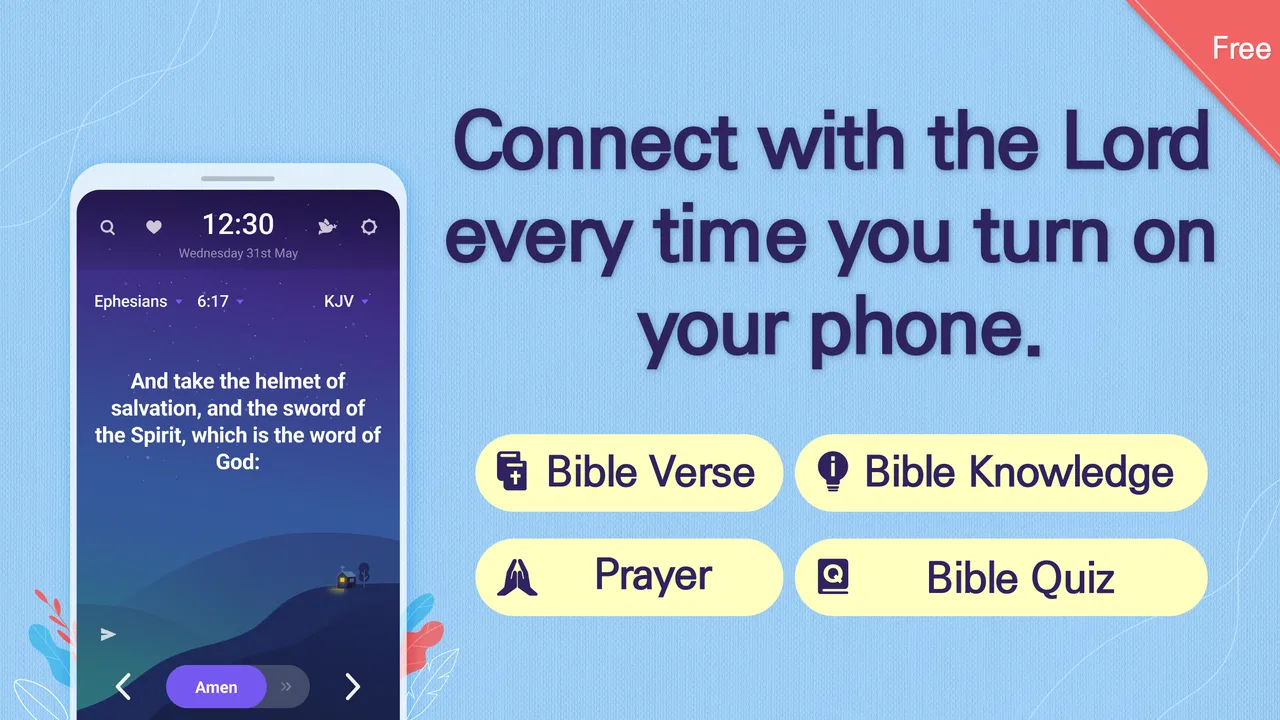
BitBible ENG -Lockscreen+Alarm
- 4.0
- Rating
- 500.00K
- Installs
- Free
- Price

 Analysis by App-foxy
I found BitBible ENG -Lockscreen+Alarm most useful in a household where a Bible app needs to fit into an existing daily routine rather than demand a long reading session. It belongs to the Books & Reference category, is free to use, and is rated for Everyone, so it is easy to consider for a shared home device. My experience is that its value comes from making Bible reading feel close at hand, especially when a phone is already part of the morning or evening routine.
The app is developed by BitBible and has built a noticeable audience, with over 500 thousand installs and an average rating of 4.0 from around 2.4 thousand ratings. Those figures suggest a practical, familiar tool rather than a niche study product. I would recommend trying it if you want a simple Bible-reading reminder around your lock-screen habits, but I would not treat it as a complete replacement for a full-featured study Bible.
How BitBible ENG fits into shared household use
The most realistic household example is a family tablet or phone that sits in a common area. One person may use it to check messages, another may use it for an alarm, and someone else may want a short Bible reading moment during the day. In that situation, BitBible ENG can be convenient because it connects Bible access with an everyday device instead of requiring every person to open a separate reading app and remember where they left off.
You May Also Like

 Blood Strike: 2.5 Anniversary
Blood Strike’s Loadouts Turn Every Drop Into a Tactical Gamble
A close look at Blood Strike’s custom loadouts: how fast access to signature weapons reshapes its battle royale rhythm, rewards preparation, and narrows the gap between fights.

 Pandora - Music & Podcasts
Pandora’s Music Is Easy to Start, but Harder to Recover
Pandora’s strength is its low-effort path from a seed to a station. Its weak spot is how much confidence it asks you to place in connection, setup, and quiet recovery.

 8 Ball Pool
 Is Built on Rivalries, Rematches, and Routine
A close look at the rivalries, rematches, shared routines, and unanswered safety questions that turn a quick pool match into a persistent mobile community.

 Samsung Music
’s Quiet Strength Is Playing What You Already Own
Its reach comes less from spectacle than from dependable access to a personal library. That simplicity is both the app’s strongest retention engine and its ceiling.

 AccuWeather: Weather Radar
AccuWeather Review: A Quick, Clear Forecast for Everyday Decisions
For everyday plans, the best forecast is the one you can understand quickly. AccuWeather makes rain timing, radar, and local conditions easy to act on, with a few trade-offs.

 Hill Climb Racing
Why Hill Climb Racing Still Turns Crashes Into One More Run
A tiny car, a bumpy hill and one more upgrade: Hill Climb Racing keeps resurfacing because its simple chaos makes every near-miss feel personal.
More From Our News Desk



I especially liked the idea of using it during small gaps: before leaving home, while waiting for an appointment, or after silencing an alarm. Those moments are different from a planned study session. The app is better suited to brief, repeated contact with Scripture than to sitting down with several commentaries, notes, and cross-references.
That distinction matters when several people share one device. A shared phone does not automatically understand who is reading, what each person prefers, or where each person wants to continue. I would therefore treat the app as a common reading doorway, not as a personal library for multiple household members. If everyone expects a private reading history or carefully separated study space, individual accounts or separate Bible apps will usually be a better arrangement.
For a parent and child using the same device, the straightforward layout can be less intimidating than a study-focused Bible packed with menus. A child can encounter a short passage without being pushed into complicated tools. At the same time, adults should remain involved in deciding how the device is used. The Everyone rating describes the general content suitability, but it does not turn the app into a substitute for family guidance or conversation.
What the first setup feels like
My advice is to install it on the device that will actually be available during the intended routine. If the goal is a morning reading habit, placing it on a phone that stays beside the bed makes more sense than installing it on a rarely used tablet. If the device belongs to the whole household, agree beforehand whether it is mainly a personal phone with occasional shared use or a genuinely communal screen.
That boundary prevents a small convenience from becoming a source of irritation. A person may appreciate Bible-related content appearing during their own routine but dislike another household member changing the reading context, alarm behavior, or general device setup. BitBible ENG can support a shared habit, but it cannot remove the need for simple household agreements.
The app is free, which makes testing it on a shared device uncomplicated. I would still spend a few minutes checking the experience from the perspective of every likely user. Ask whether the text is comfortable to read, whether the timing suits the household, and whether the app feels helpful rather than intrusive. A setup that works for one person at six in the morning may not work for someone who uses the same device late at night.
The current release is version 1.7.24, and the app supports Android 7.0 or later. That makes it relevant for many older Android phones that may still be used as household devices. Before choosing an old spare phone for this purpose, I would confirm that the device handles the app comfortably and that its battery and screen are still practical for regular use. Compatibility is only the starting point; a slow or unreliable shared device can undermine the routine.
Keeping personal boundaries clear
A shared device creates a subtle account problem even when an app itself is simple. If one person reads in the morning and another checks the phone later, neither should assume the app will preserve separate personal spaces unless that behavior is clearly available in the version being used. I would avoid treating one visible reading position as proof of individual progress.
This is one of the app’s important trade-offs. Its convenience comes from being close to the lock screen and daily device activity, but that same closeness means it is not the best place for confidential notes, private reflections, or a carefully organized long-term study plan. For those needs, I would choose a dedicated personal Bible app with the account and note structure that matches the user.
My practical solution is to separate purposes. Let BitBible ENG handle quick reading prompts or a common household moment, while each person keeps deeper study, bookmarks, and personal notes in their own preferred tool. That combination avoids asking one lightweight app to do two very different jobs.
This approach also helps when a household includes people with different reading preferences. One person may want a short passage, another may want a complete chapter, and another may prefer audio or extensive reference material. The app can remain the simple shared option without forcing the entire family into one method.
Using the alarm idea without disrupting the home
The alarm element is central to the app’s identity, but it should be introduced carefully in a shared environment. An alarm is not merely a personal reminder when several people sleep, work, or study near the same device. Before relying on it, I would choose a time that does not create unnecessary disturbance and make sure everyone who may hear it understands why it is there.
For one person’s private phone, an alarm-linked Bible routine can be a useful prompt. It turns intention into a repeatable action: the device signals that it is time to pause, and the reading is immediately nearby. For a family device, however, the same feature can feel like one person has scheduled the whole household. That is not a flaw in the reading content, but it is a real coordination issue.
I would begin with a low-pressure trial rather than making the alarm part of the household schedule immediately. Use it at a time when a missed reading causes no problem, then see whether the routine feels natural. If the alarm becomes annoying, the family may associate the app with disruption instead of reflection. The best setup is the one people willingly keep using.
Another useful distinction is between a reminder and an obligation. BitBible ENG can help someone remember to read, but it cannot decide whether that moment should be private, shared, quiet, or discussed afterward. In my view, the app works best when the household treats the prompt as an invitation rather than a rule imposed on everyone.
Age, trust, and conversations around the app
Because the content rating is Everyone, I can see why a household might feel comfortable considering the app for a broad age range. Still, age suitability and personal readiness are not identical. Younger readers may need help understanding passages, unfamiliar language, or questions that arise during reading. The app can open the door to that conversation, but it does not replace an adult’s explanation.
I would introduce it to a child as a reading tool, not as an unsupervised authority. If a child asks what a passage means, the answer should come through a trusted parent, teacher, or faith leader rather than assuming the app itself provides all the needed context. This is particularly important because a short reading format can encourage quick exposure without the background that makes difficult material easier to understand.
The same principle applies to teenagers. A simple app may be welcome because it does not feel like a formal assignment, but trust still depends on respecting the young person’s privacy and not turning every reading moment into a test. If the device is shared, adults should be honest about what is common and what is personal. Quietly monitoring someone’s use can damage trust even when the original intention is supportive.
For adults in the home, the main question is preference. Some will appreciate having Scripture close to a familiar device. Others may find lock-screen or alarm-based prompts distracting, especially if they already use the phone for work, sleep tracking, or urgent communication. I would not install it for everyone without asking. A shared spiritual routine works better when participation is voluntary.
The Everyone label also makes the app easier to recommend as a general household option, but it should not be confused with a complete family-management system. I would not expect it to establish age-specific boundaries, separate family profiles, or coordinate everyone’s personal use automatically. Those responsibilities remain with the people managing the device and the household routine.
Where it beats the usual alternatives
Compared with opening a Bible website in a browser, BitBible ENG feels more purpose-built for repeated access. A browser requires a search, a saved tab, or a remembered address. This app is more direct for someone who wants Bible reading connected to a phone habit. That reduced friction is its strongest practical advantage.
Compared with a large study Bible app, it is easier to approach when the reader wants less clutter. Study apps often shine through multiple translations, notes, plans, highlights, and reference tools. Those features are valuable when I am researching a passage, but they can also make a short reading moment feel like a project. BitBible ENG is more appealing when simplicity matters more than depth.
Compared with a paper Bible, the app is more convenient for a device-centered routine and easier to keep available during travel. Paper still wins for people who want a screen-free experience, a physical reading pace, or a book that can be shared without battery concerns. I would not claim the app replaces that experience; it offers a different kind of access.
Compared with a general reminder app, BitBible ENG has a clear connection between the prompt and the intended reading activity. A generic alarm may remind me to read but leave me to decide what to open next. Here, the Bible purpose is built into the experience. The trade-off is that a general reminder offers more flexibility for household scheduling, while this app is more focused.
Small habits that make it more useful
One non-obvious benefit is that the app can act as a transition marker. Instead of trying to create a long study block, I can attach a short reading moment to something that already happens, such as waking up or putting the phone down for the evening. This works because the existing habit supplies the cue. The app does not need to carry the entire burden of motivation.
A second useful approach is to keep shared reading separate from private interpretation. A household might read at the same general time, but each person can decide whether to continue thinking about the passage alone, discuss it later, or move to another study resource. That prevents the app from becoming a forced group activity while still giving the home a common point of connection.
A third insight is to use the app as a test of routine before investing in a more elaborate setup. If a household cannot maintain a simple reading habit supported by a phone, adding multiple plans, notes, and study tools may only create more maintenance. BitBible ENG is useful here because its modest approach exposes whether the real obstacle is access or consistency.
I would also recommend reviewing the arrangement after a week or two of ordinary use. Notice whether the alarm is respected, whether the shared device causes confusion, and whether anyone feels pressured. If the routine works, keep it simple. If it does not, change the timing or move the app to a personal device instead of blaming the reading goal itself.
Limitations worth considering before installing
The app’s focused design is also its main limitation. Readers who want extensive study tools, personal annotations, multiple ways to organize material, or a rich reference environment may outgrow it quickly. In that case, a full Bible study app is the better choice, even if it takes longer to learn.
Shared-device use introduces another limitation: convenience does not automatically mean separation. Different household members may have different expectations about reading position, reminders, and privacy. I would not rely on one installation to represent several independent spiritual routines unless the actual experience clearly supports that arrangement.
The alarm connection may also be unsuitable for people who need a completely quiet phone or who already manage several reminders. A reading prompt can be encouraging when it arrives at the right time, but distracting when it competes with work, school, sleep, or another person’s schedule. I see this as a reason to configure the routine thoughtfully, not as a reason to assume the feature suits everyone.
Finally, the app is aimed at access rather than comprehensive interpretation. Someone looking for historical background, structured lessons, extensive cross-referencing, or carefully managed personal study will probably prefer a different tool alongside it. BitBible ENG can be the first step in a reading habit, but it should not be judged as though it were designed to be an entire theological library.
My household verdict
After considering both individual and shared use, I see BitBible ENG -Lockscreen+Alarm as a practical, low-barrier Bible companion for people who want reading connected to an everyday Android routine. Its free price, Everyone rating, and support for Android 7.0 or later make it approachable for a wide range of household devices. The developer, BitBible, has kept the idea focused enough that a new user can understand its purpose quickly.
I would recommend it to a person who wants a gentle prompt, a common family reading doorway, or a way to make Bible access more visible during the day. I would be more cautious about recommending it as the only app for a household with separate users, strong privacy expectations, or advanced study needs. In those cases, use it for the shared or reminder-based part of the routine and keep personal study elsewhere.
Its rating of 4.0 reflects the kind of balanced experience I had: the central idea is useful, but the right fit depends heavily on how a device is shared and how much depth the reader expects. With clear boundaries around alarms, privacy, and personal interpretation, it can support a calm household habit. Without those boundaries, the same convenience may feel intrusive.
My final recommendation is to start with one device and one realistic routine. Do not promise a major family program; simply see whether the app helps people read more consistently without creating friction. If it does, BitBible ENG earns a place as a handy household companion. If the home needs separate accounts, detailed study tools, or complete control over personal reading spaces, a more specialized alternative will serve better.
FAQs for BitBible ENG -Lockscreen+Alarm
01What is BitBible ENG - Lockscreen+Alarm, and what features does it offer?
BitBible ENG - Lockscreen+Alarm is an innovative app that combines a digital Bible with practical utilities like a lockscreen and alarm system. It allows users to access biblical texts conveniently while offering daily scripture notifications, customizable alarms, and a unique lockscreen experience that integrates spiritual insights into your daily routine.
02Is BitBible ENG - Lockscreen+Alarm free to download and use?
Yes, BitBible ENG - Lockscreen+Alarm is free to download on both Android and iOS platforms. However, it may offer in-app purchases or premium features that enhance the user experience, such as additional themes, ad-free usage, or exclusive scripture content. Check the app store for any specific pricing details.
03How does the lockscreen feature work in BitBible ENG - Lockscreen+Alarm?
The lockscreen feature in BitBible ENG provides daily scripture verses directly on your phone's lockscreen. This feature allows you to receive spiritual inspiration and reflection every time you unlock your device. You can customize the appearance and frequency of these verses to fit your personal or spiritual preferences.
04Can I customize the alarm settings in BitBible ENG - Lockscreen+Alarm?
Yes, BitBible ENG offers customizable alarm settings. Users can set multiple alarms with different sounds, including hymns or nature sounds. Additionally, you can link your alarms to specific Bible verses, providing a unique wake-up experience that combines practicality with spiritual motivation.
05Is an internet connection required to use BitBible ENG - Lockscreen+Alarm?
While BitBible ENG can function offline for reading downloaded scriptures, an internet connection is needed for initial downloads, updates, and accessing certain online features like daily verse notifications. Ensure you have an internet connection when setting up the app to fully enjoy its features.
Pros
- User-friendly interface with easy navigation.
- Customizable lock screen with Bible verses.
- Daily alarms for scripture reminders.
- Offline access to Bible content.
- Regular updates with new features.
Cons
- Limited translation options available.
- Ads can be intrusive at times.
- Some features require in-app purchases.
- Initial setup may be time-consuming.
- Minor bugs reported in alarm function.

BitBible ENG -Lockscreen+Alarm
Gallery